

When you hear the word “foam,” what do you think of? Perhaps the soft cushioning beneath your body as you sink into a mattress or the lightweight material that fills the insides of packaging boxes. But behind these simple uses lies a complex set of characteristics that determine how foam performs in various applications. Among these, density, weight, and firmness are often discussed but frequently misunderstood. It’s easy to conflate them—density, after all, seems like it should correlate with firmness, and weight sounds like it’s directly related to both. But is that the case? Not quite.
In industries like packaging, automotive manufacturing, and even the furniture sector, understanding these properties is crucial. It’s not just about what feels soft or hard to the touch, or what appears light or heavy—it’s about how these properties impact the longevity, performance, and effectiveness of the material in specific contexts. Let’s explore foam’s dense and sometimes murky world, where science and practical application intersect in unexpected ways.
1. What is Foam Density?
Before we get into the nitty-gritty of how density, weight, and firmness relate (or don’t), let’s define foam density. At its core, density refers to the mass of a material per unit volume, typically expressed in kg/m³. For foam, this measurement is essential because it gives us a clue about the material’s overall performance and resilience. A higher density foam tends to be stronger, more durable, and able to withstand more wear and tear, while a lower-density foam might offer more comfort or softness but won’t last as long under pressure.
But let’s take a step back. Density isn’t inherently tied to how “firm” foam feels, as we’ll see in a bit. It’s more about how much material is packed into the foam—the more densely packed, the more resilient and stable it is. It’s like comparing a densely packed suitcase full of clothes to a loosely packed one. The former feels sturdier and can carry more weight without breaking.
Foams typically fall within the following density ranges:
- Low density foam: Between 24-48 kg/m³ (suitable for lightweight applications like pillows or body bolsters)
- Medium density foam: 48-80 kg/m³ (used in mattress toppers, seat cushions)
- High density foam: 80-120 kg/m³ (ideal for heavy-use applications like car seats, furniture cushions, and mattresses)
2. How to Measure Foam Density?

Now that we know density is a critical characteristic, how do we actually measure it? Simple. Density is typically measured by determining the mass of a specific volume of foam.
Step 1: Cut a sample of foam
Start by cutting a sample of foam, usually into a 1 cubic meter block for standard measurements. The size matters, and it’s essential to use a representative sample that reflects the foam’s overall characteristics. If the foam is inconsistent in thickness or texture, you could end up with misleading results.
Step 2: Weigh the sample
Next, weigh the foam block to determine its mass. This can be done using a precision scale. Let’s say you measure out 40 kilograms for a 1 cubic meter block of foam.
Step 3: Calculate the density
Using the formula: Density (kg/m³)=Mass (kg)Volume (m³)\text{Density (kg/m³)} = \frac{\text{Mass (kg)}}{\text{Volume (m³)}}
For our example, if the foam weighs 40 kilograms, the density is 40 kg/m³.
Step 4: Evaluate the results
After performing these measurements, you can assess the foam’s density. Higher densities typically correspond to more durable, rigid foam, whereas lower densities point to softer, more compressible foam.
3. Foam Weight vs. Density: Understanding the Difference

Density is often confused with weight, but they’re not the same thing. It’s easy to see why this happens. After all, a foam mattress that weighs more surely must be denser, right?
Not necessarily.
Let’s break it down. Weight refers to the total mass of the foam product, whereas density refers to how much mass is packed into a given volume. Two foam products can have the same weight but different densities, depending on their volume and how much air is trapped inside. So while density affects the foam’s performance (e.g., durability), weight impacts things like shipping costs, handling, and overall convenience.
For example, consider a mattress. A 6-inch thick, queen-sized mattress might have a density of 50 kg/m³. But that doesn’t mean it weighs just 50 kg. With additional layers, materials, and structural components, the total weight could easily reach 21 kilograms (or more), which is much heavier than the raw foam density would suggest.
So when specifying or purchasing foam, it’s crucial to understand the difference between the foam’s density and the total weight of the product. If you need to calculate transport costs or space requirements, knowing the actual weight is key. If you’re concerned about product lifespan and performance, then density is the number you’ll need to focus on.
Below is a simple table illustrating the difference between density and weight:
| Characteristic | Density | Weight |
|---|---|---|
| Definition | The mass per unit volume of foam. | The total mass of the foam product. |
| Units | Measured in kg/m³ | Measured in kilograms (kg) |
| Impact on Foam | Affects performance and durability. Higher density means more durable foam. | Affects shipping costs and handling. Heavier foam means higher transportation costs. |
| Measurement | Measured using a formula: Density=MassVolumeDensity = \frac{Mass}{Volume} | Measured by weighing the foam product as a whole. |
| Example | A foam with a density of 50 kg/m³ is denser than one with 30 kg/m³. | A foam mattress might weigh 25 kg even though the material inside has a density of 50 kg/m³. |
4. What is Foam Firmness?
Firmness is one of the most misunderstood aspects of foam. It’s often used interchangeably with density, but they’re entirely different properties. While density refers to the mass per unit volume, firmness describes how a foam reacts to pressure. In short, firmness refers to how the foam feels when you press into it.
One of the most common methods for measuring firmness is Indentation Load Deflection (ILD), which evaluates how much force is required to compress the foam to a specific thickness. ILD is measured by placing a circular plate (typically 50 square inches) onto a foam sample and measuring how many pounds of pressure are needed to compress the foam by 25%.
Typical ILD values fall within the range of 8 to 70, with higher values corresponding to firmer foams. If foam has a 36 ILD, it means that 36 pounds of force are needed to compress a 15 x 15-inch square of foam by 25%. On the other hand, softer foams may have an ILD as low as 8.
Firmness is highly subjective and varies widely depending on the intended application. For seating applications like sofa cushions, low ILD values (soft) are often preferred, while higher ILD values (firmer) are sought in more supportive applications like mattresses or car seats.
5. How to Measure Foam Firmness?
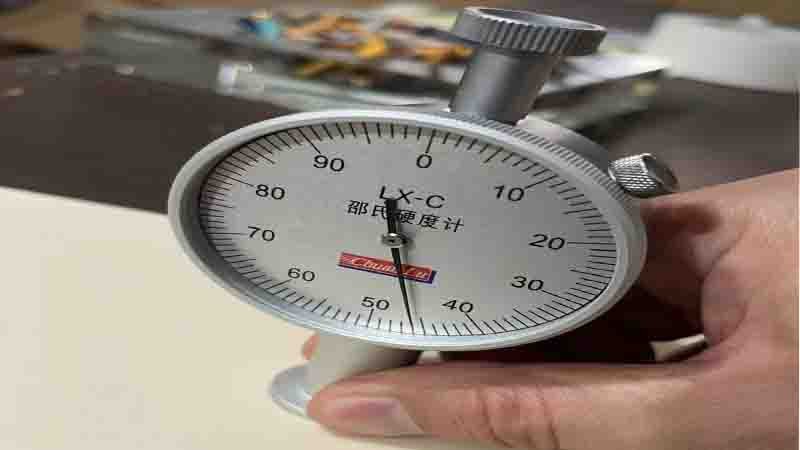
We need the machine for help when measuring the foam firmness.
just take closed-cell polyethylene (PE) foam for example. measuring firmness requires a more specialized tool than the standard ILD test. Enter the Shore C durometer.
A Shore C durometer is a tool designed to measure the hardness (or firmness) of materials like rubber, elastomers, and foam. When testing closed-cell PE foam, the Shore C scale is used to determine how resistant the foam is to indentation. The scale ranges from 0 to 100, with higher values indicating firmer foam.
How does the Shore C durometer work?
The tool has a spring-loaded needle that applies pressure to the foam. The harder the foam, the less the needle penetrates, and the higher the Shore C reading. Softer foam will allow more penetration, resulting in a lower reading.
For example, a closed-cell PE foam might measure at 40 Shore C—meaning the foam is fairly firm. This measurement is critical in applications where you need to know how well the foam will handle pressure, like in automotive seat cushions, protective packaging, or even insulation materials.
To measure, simply place the durometer’s probe on the foam surface, apply pressure, and record the value that appears on the scale. It’s important to conduct multiple tests to ensure consistency and accuracy.
6. The Relationship Between Density and Firmness

Now that we understand how to measure both density and firmness, you may be wondering: How do these two characteristics relate to one another? The short answer: Not as much as you might think.
While both density and firmness play significant roles in a foam’s performance, they operate on separate axes. Density affects the foam’s durability and resilience—how well it holds up to wear and tear over time. Firmness, on the other hand, impacts the comfort and support the foam provides in an application.
A high-density foam can be soft if it has a low ILD, while a low-density foam can feel firm if it has a high ILD. It’s all about balancing these properties to meet your specific needs. For instance, in automotive applications, a firm, high-density foam is used for impact resistance. Meanwhile, in mattresses, a combination of lower-density, softer foam provides comfort, with denser foam used for support.
We can understand more easily by below table:
| Foam Characteristic | Density | Firmness |
|---|---|---|
| Definition | The mass per unit volume of foam, measured in kg/m³. | How well the foam resists compression or how it feels when pressure is applied. |
| Measurement | Measured by weighing a given volume (e.g., 1 cubic meter) of foam. | Measured using Indentation Load Deflection (ILD) or Shore C hardness for closed-cell foam. |
| Key Impact | Affects durability, resilience, and long-term performance. | Affects comfort and support, determining how soft or firm the foam feels. |
| Interrelationship | Higher density generally leads to a more durable foam but doesn’t necessarily make it firmer. | High-density foam could be soft or firm depending on the ILD or Shore C hardness. |
| Example | A foam with a density of 80 kg/m³ might be used for a durable car seat cushion. | A foam with a high ILD value (e.g., 40 ILD) will feel firmer, even if it’s low-density. |
7. Choosing the Right Foam: Key Considerations
Understanding the relationship between density and firmness helps you make more informed decisions when selecting foam for a project. Whether you’re looking for something to cushion fragile items, provide comfort in a chair, or offer support in a mattress, being clear on your **
performance needs** is crucial. You can tailor your choice based on:
- Application requirements: Is the foam for comfort, support, or protection?
- Durability: Does the foam need to withstand heavy use or wear and tear?
- Budget: Higher-density foams tend to be more expensive due to their durability.
8. Conclusion
In the world of foam, density, weight, and firmness are three of the most fundamental characteristics, yet they are often misunderstood or misused. Understanding their differences and how they interrelate can make all the difference in choosing the right material for your needs. Whether you’re outfitting a car, creating a mattress, or packaging fragile goods, getting these specifications right is essential for achieving the best balance of performance, comfort, and durability.
For further guidance on selecting the perfect foam based on your specific needs, contact FS Foam today for expert advice and information!
FAQs
1. What is the difference between foam density and weight?
Density refers to the mass per unit volume of foam, measured in kg/m³. Weight, on the other hand, is the total mass of the foam product itself. While density is a material property, weight depends on the size and thickness of the foam product.
2. How does foam firmness affect comfort?
Firmness is how well foam resists compression. Softer foams have lower ILD values, offering comfort by sinking into the body. Firmer foams, with higher ILD values, provide more support and less sinkage, making them ideal for applications that require more structure.
3. What is the best density for a mattress?
For mattresses, medium to high-density foam (around 50-80 kg/m³) is often best for support and durability. Lower-density foams are more suited to comfort layers or toppers.
4. How do I know which foam is best for my application?
To choose the right foam, consider its density, firmness, and durability needs for your specific application. For comfort, opt for lower-density foam with a soft firmness rating; for support or structural uses, look for higher-density foam with firmer characteristics.
5. What is Shore C hardness testing?
Shore C testing measures the firmness of closed-cell foams using a durometer. The test gauges how much resistance the foam offers to indentation, with higher readings indicating firmer materials.